When choosing between an injection and surgery for a herniated disc, the starting point is almost always treatment without surgery: in most people, leg pain improves without an operation, and an injection can help them get through the phase of worst pain. Surgery becomes the better option when the pain does not improve after a few weeks of proper treatment, when it seriously disrupts daily life, or when there is weakness, numbness between the legs, or a change in bladder or bowel control.
This is one of the conversations I have most often in my office. The patient arrives with the MRI in hand and wants to know whether they “will need an operation”. Very often, the least invasive treatment for them at that moment is not surgery. And when it is, understanding why helps them decide calmly.
Can a herniated disc get better without surgery?
Yes, and it happens often. A systematic review published in Clinical Rehabilitation in 2015 gathered studies with follow-up MRI and calculated the chance of a lumbar disc herniation shrinking on its own. The chance was highest precisely in the herniations that look most alarming on the scan: about 96% for sequestrations and 70% for extrusions, compared with 41% for protrusions and 13% for bulges (Chiu and colleagues, 2015; abstract on PubMed).
That is why the first step is usually treatment without surgery: pain control, physiotherapy, guided exercise and a gradual return to activities. The guideline from NICE, the UK health institute, for low back pain and sciatica follows the same approach and reserves surgery for people who have not improved with non-surgical treatment (NICE NG59).
What does an injection do for a herniated disc?
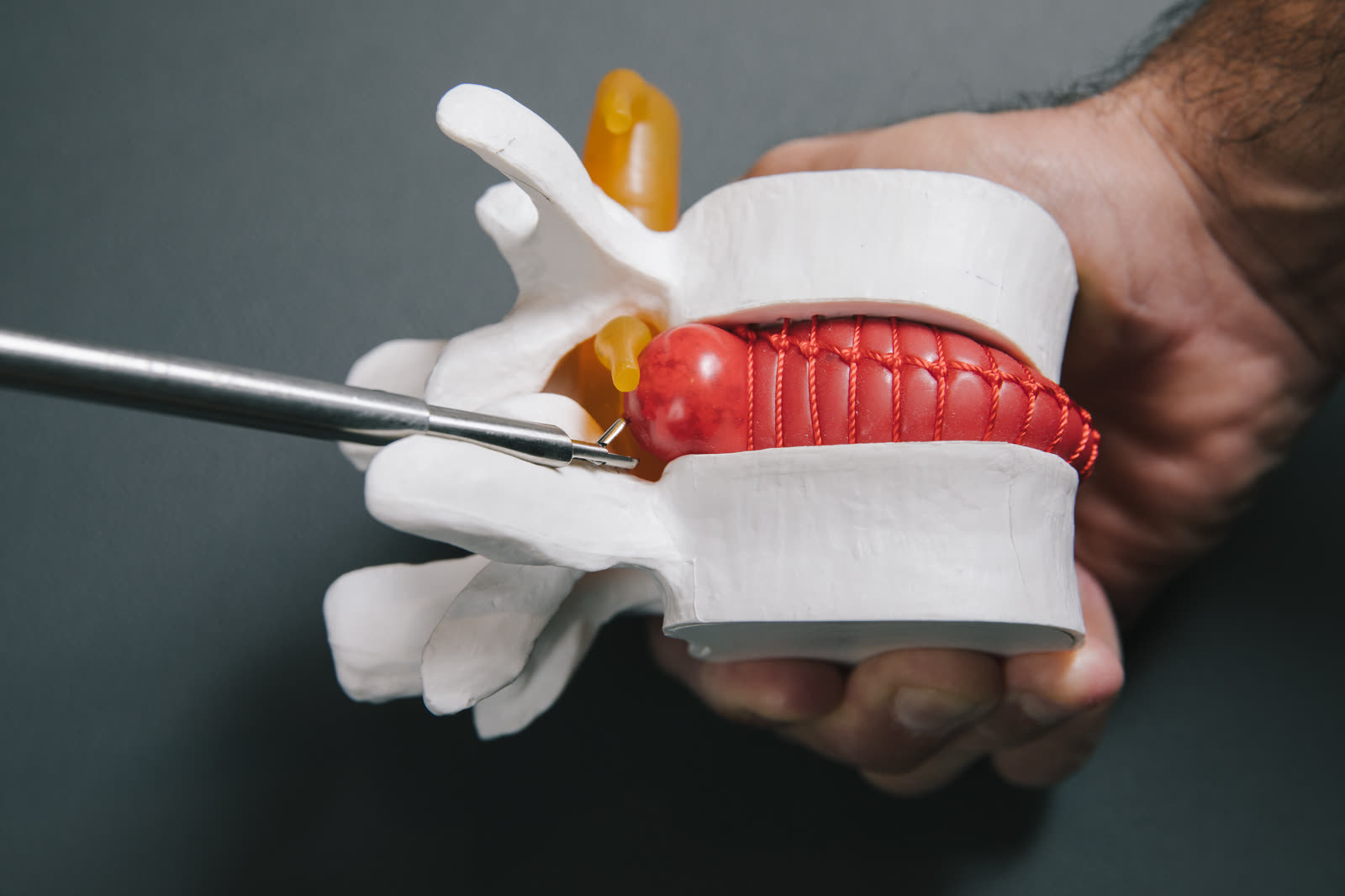
An injection does not remove the herniation. It delivers a corticosteroid and a local anaesthetic close to the inflamed nerve. This is how I explain it to patients: the injection aims to reduce inflammation and pain so that physiotherapy becomes possible and the body has time to recover, without surgery. It is an attempt to avoid surgery.
I always perform injections under image guidance: with fluoroscopy in the operating room, or with ultrasound in the clinic.
On average, the effect is modest and short term. The 2020 Cochrane review, with 25 trials and about 2,470 patients, showed that epidural corticosteroid injections improve leg pain and disability slightly more than placebo, from the first weeks up to about three months, with no clear difference in minor side effects (Cochrane, 2020). The North American Spine Society (NASS) guideline for lumbar disc herniation with sciatica also recommends transforaminal injections for short-term relief (Kreiner and colleagues, The Spine Journal, 2014; abstract on PubMed).
In practice, this means injections work well for some people and less for others. That is why they serve as a bridge within a plan, not as a stand-alone solution.
Operate early or wait: what happens on each path?
Surgery relieves leg pain faster. Three large studies compared the two paths:
- Sciatica of 6 to 12 weeks. A Dutch trial with 283 patients compared early surgery with prolonged non-surgical care. Those who had surgery improved faster. At one year, results looked similar, but one detail changes how to read them: 44% of the patients randomised to non-surgical care ended up having surgery during the study (Peul and colleagues, New England Journal of Medicine, 2007, with two-year follow-up in the BMJ, 2008; BMJ article).
- Sciatica of 4 to 12 months. A Canadian trial with 128 patients compared microdiscectomy with six more months of non-surgical care. At six months, leg pain was lower in the surgery group: on average 2.8 versus 5.2 on a 0 to 10 scale (Bailey and colleagues, New England Journal of Medicine, 2020; abstract on PubMed).
- Eight years of follow-up. The American SPORT study followed about 1,240 patients for eight years. There too, nearly half of those randomised to non-surgical care ended up having surgery. When the researchers compared patients by the treatment they actually received, those who had surgery had less pain, better function and less bothersome sciatica throughout the eight years (Lurie and colleagues, Spine, 2014; full article).
What is crossover, and why does it change how we read these studies?
This switching between groups has a name: crossover. Imagine comparing people who travel by car with people who walk, where almost half of the walkers get a lift halfway. In the end, both groups arrive at similar times, but not because walking is as fast as driving. With crossover, the “non-surgical” group comes to include many operated patients, and the final comparison shrinks the real difference between the two treatments. That is why, when the analysis looks at the treatment each patient actually received, the advantage of surgery shows more clearly.
What we see in practice today points in the same direction as the literature: when surgery is well indicated, recovery is faster and there is a lower chance of being left with nerve pain, tingling or odd sensations in the leg after treatment. How long the nerve has been compressed plays a part. In a study of 334 patients who had microdiscectomy, those who had had leg numbness for longer before surgery were more likely to still have numbness at the end of follow-up (Shi and colleagues, Medicine, 2023; abstract on PubMed).
So waiting safely is a valid option in the first weeks, but prolonging the pain for many months has a cost. The right moment depends on how much the pain is disrupting each person’s life.
When is surgery for a herniated disc the better option?
When a patient asks me whether it is time for an injection or for surgery, I explain that surgery is indicated in these situations:
- Significant weakness that affects function, such as a foot that “drags” or difficulty standing on tiptoe.
- Pain that persists for more than 4 to 6 weeks despite adequate treatment, usually medication and physiotherapy.
- Cauda equina syndrome, which is an emergency (see the warning signs below).
- An injection that did not work.
- Disabling pain that prevents any activity. In these cases, I discuss with the patient the option of trying an injection first to avoid surgery.
If an injection is a reasonable alternative, I usually recommend a single one and wait 1 to 2 weeks to see the response before recommending surgery.
Why does the length of pain change the decision?
Symptom duration also matters. When the pain has lasted more than 4 to 6 weeks, I explain that surgery is usually the better choice, because the chance of an injection working decreases over time. This happens because a herniation triggers an inflammatory reaction and, with it, scar tissue forms around the nerve. The longer we wait, the more the nerve becomes trapped, and an injection cannot free it.
Similarly, studies that looked at symptom duration point in the same direction. In an analysis of the American SPORT study, with about 1,200 patients, those with symptoms for more than six months had worse pain and function outcomes, with or without surgery (Rihn and colleagues, Journal of Bone and Joint Surgery, 2011; abstract). In a Danish study of 1,607 operated patients, satisfaction with surgery was 74% among those with leg pain for less than three months, versus 49% among those with pain for more than two years (Spine, 2023; full article). And for injections, a Korean study showed that a shorter symptom duration was one of the factors linked to a better response (Park and colleagues, Medicina, 2019; full article).
The decision is always shared. In the consultation, I explain what the scan shows, what it does not explain, and the risks of operating and of not operating, so that the patient takes part in the choice. I wrote about the real risks of surgery, and the myths, in fear of spine surgery: what is real and what is a myth.
What is herniated disc surgery like today?
In most cases, minimally invasive techniques can be used, such as endoscopic spine surgery or tubular microsurgery. As a result, the incision is small and the goal is to remove only the fragment pressing on the nerve. Young patients can often go home the same day or the next day; older patients I often keep in hospital overnight.
When should I see a doctor urgently?
Seek care without delay if, along with the pain:
- your leg loses strength or the weakness is getting worse;
- you notice numbness between your legs (the area that touches a bicycle saddle);
- you lose bladder or bowel control, or have difficulty urinating.
In fact, these signs may indicate significant nerve compression, as in cauda equina syndrome, and need assessment the same day, in an emergency department.
It is also worth booking a consultation if your leg pain does not improve within 2 to 3 weeks, if it gets worse instead of better, or if you have had an injection and the pain came back. Therefore, an early assessment helps you not to miss the window in which an injection has the best chance of working.
Frequently asked questions
Does a spinal injection hurt?
It is always image guided. In the clinic, with ultrasound, it is done under local anaesthesia only. In the operating room, with fluoroscopy, it can be done under local anaesthesia or with sedation. Most people feel pressure and brief discomfort. After the injection, patients can return to their usual activities the next day. The time needed to get back to everything depends more on the herniation symptoms than on the injection itself.
How long does the effect of an injection last?
It varies from person to person. In studies, the average benefit appears in the first weeks and lasts up to about three months (Cochrane, 2020). If the herniation shrinks during that period, the improvement can last.
Does an injection delay or interfere with surgery?
It does not prevent future surgery. What should be avoided is repeating injections for a long time without real improvement, postponing a decision that could already have been made.
Can the herniation come back after surgery?
It can, in some patients, at the same level or at another. Post-operative care, a gradual return to effort and strengthening help protect the spine. This risk is part of the conversation before deciding.
Can the first assessment be done remotely?
Yes. In an online consultation, I review your history, symptoms and MRI images, and explain the options before any travel. Consultations are available in Portuguese, English or French.
Assessment in Brazil and online
If you have a herniated disc and are unsure whether to continue treatment, have an injection or have surgery, an assessment helps you see your case clearly. I see patients in Avaré (SP), Londrina (PR) and São Paulo (SP), Brazil, and also by online consultation. Appointments via WhatsApp: +55 14 99790-1060.
Dr. Alexandre Jaccard, orthopaedic surgeon, spine surgeon · CRM 116.476/SP – 27.412/PR · RQE 111.183
Consultations in Avaré (SP), Londrina (PR) and São Paulo (SP), Brazil. Appointments: +55 14 99790-1060.
Published on 22/11/2026 · Reviewed on 22/11/2026This content is for information only and does not replace a medical consultation.
Sources
- Chiu CC et al. The probability of spontaneous regression of lumbar herniated disc: a systematic review. Clinical Rehabilitation, 2015. https://pubmed.ncbi.nlm.nih.gov/25009200/
- Oliveira CB et al. Epidural corticosteroid injections for lumbosacral radicular pain. Cochrane Database of Systematic Reviews, 2020. https://www.cochrane.org/evidence/CD013577
- Kreiner DS et al. An evidence-based clinical guideline for the diagnosis and treatment of lumbar disc herniation with radiculopathy (NASS). The Spine Journal, 2014. https://pubmed.ncbi.nlm.nih.gov/24239490/
- Peul WC et al. Surgery versus prolonged conservative treatment for sciatica. New England Journal of Medicine, 2007; two-year follow-up: BMJ, 2008. https://doi.org/10.1136/bmj.a143
- Rihn JA et al. Duration of symptoms resulting from lumbar disc herniation: effect on treatment outcomes (SPORT). Journal of Bone and Joint Surgery, 2011. https://www.qxmd.com/r/22012528
- Impact of preoperative duration of symptoms on patient satisfaction, outcomes and complications after lumbar discectomy. Spine, 2023. https://pmc.ncbi.nlm.nih.gov/articles/PMC10412080/
- Park DY, Kang S, Park JH. Factors predicting favorable short-term response to transforaminal epidural steroid injections for lumbosacral radiculopathy. Medicina, 2019. https://pmc.ncbi.nlm.nih.gov/articles/PMC6571939/
- Bailey CS et al. Surgery versus conservative care for persistent sciatica lasting 4 to 12 months. New England Journal of Medicine, 2020. https://pubmed.ncbi.nlm.nih.gov/32187469/
- Lurie JD et al. Surgical versus non-operative treatment for lumbar disc herniation: eight-year results for the Spine Patient Outcomes Research Trial (SPORT). Spine, 2014. https://pmc.ncbi.nlm.nih.gov/articles/PMC3921966/
- Shi L et al. Risk factor of residual leg numbness after lumbar microdiscectomy for lumbar disc herniation. Medicine, 2023. https://pubmed.ncbi.nlm.nih.gov/37904414/
- National Institute for Health and Care Excellence. Low back pain and sciatica in over 16s: assessment and management (NG59). https://www.nice.org.uk/guidance/ng59/chapter/Recommendations