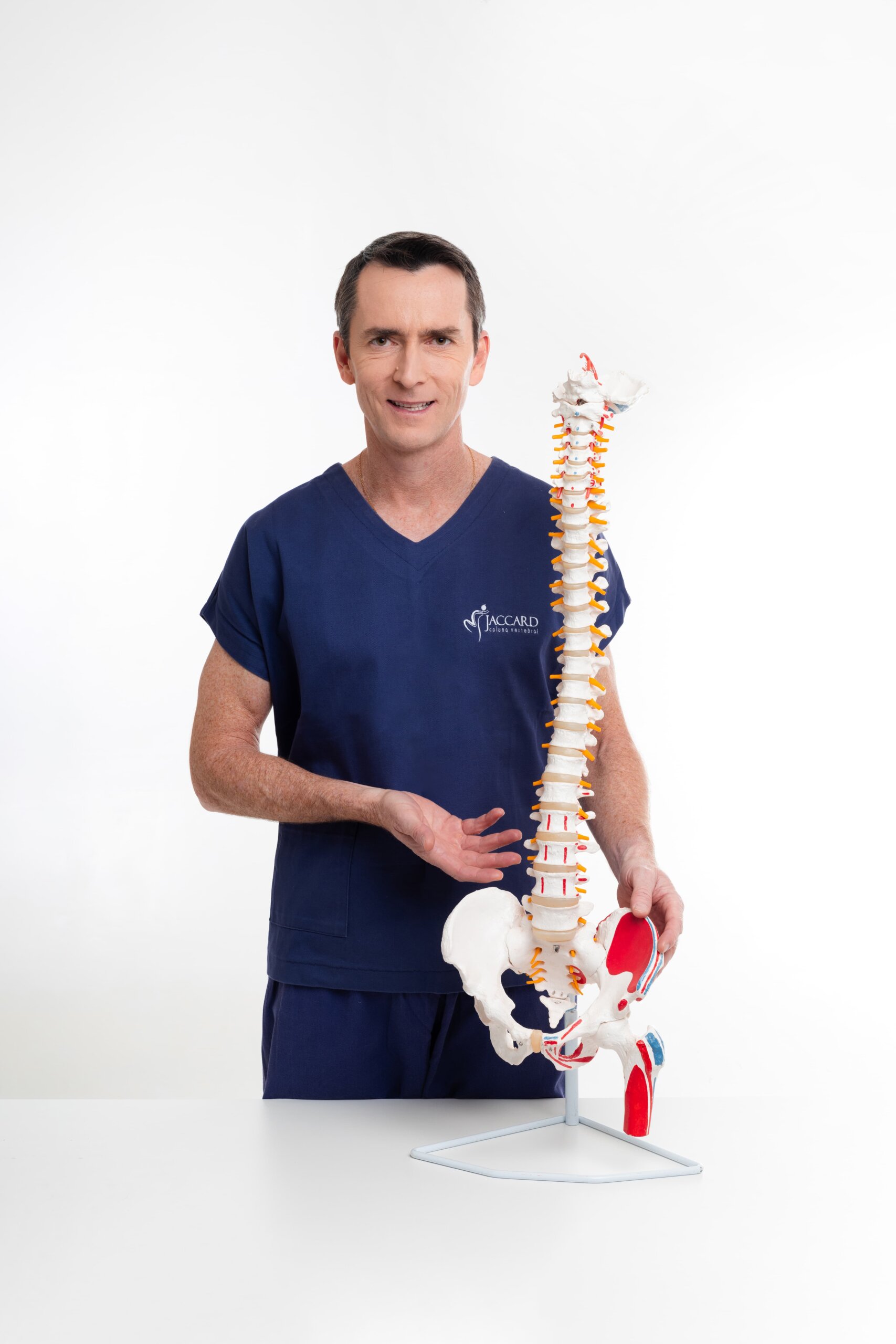
Fear of spine surgery is common, and the biggest fear of all, ending up in a wheelchair, is largely a myth: serious damage to the spinal cord or nerves is rare, and surgical techniques have become less and less invasive. The real risks do exist and should be explained before surgery, with numbers. Telling one from the other is what allows you to decide calmly.
The questions patients send me before surgery are always similar: “Will I be able to walk?”, “Will I go home the same day?”, “How long will I be off work?”, “Will I get back to the things I enjoy?”. This article answers each of them.
Can spine surgery leave me in a wheelchair?
It is very unlikely. The largest registry on the subject, from the Scoliosis Research Society, analyzed 108,419 spine surgeries, including scoliosis and deformity surgery, which are the most complex. A new neurological problem appeared in about 1% of them, most often in a single nerve root. Injury to the spinal cord or the cauda equina, the most serious kind, appeared in about 0.3% (Hamilton et al., Spine, 2011; abstract on PubMed).
I explain this in the office using anatomy. The lower back has several levels (L1, L2, L3, L4, L5), and a nerve leaves the spine at each level. We use all of them to walk. In most surgeries the treatment is very targeted: freeing one nerve, at one single point. That is why, even if that nerve is injured, it often does not stop the patient from walking and getting back to normal life.
Why is spine surgery so frightening?
Because the spine protects the spinal cord and the nerves, and “operating near a nerve” sounds scary. Add to that the stories of surgeries from decades ago, with large incisions, long hospital stays and slow recovery.
Techniques have changed a lot. Today, when surgery is needed, a minimally invasive technique can be used in most cases, such as endoscopic spine surgery or tubular microsurgery, with a small incision and a quick discharge.

Can fear get in the way of recovery?
It can, which is why fear is worth addressing before surgery. A study published in PLoS ONE in 2018 showed that the fear-avoidance model (fear of moving and catastrophic thoughts about pain) helped predict more pain and more disability in the weeks after lumbar disc surgery (The Fear Avoidance Model predicts short-term pain and disability following lumbar disc surgery).
That is why I always talk with the patient and the family the day before or during the week of surgery and explain the whole surgical journey: admission day, anesthesia, discharge, the dressing and going home. Understanding the process is part of the treatment.
Does every back pain need surgery?
No. My everyday principle is to use the least invasive procedure that can solve each person’s problem, and often that means no surgery at all. Physical therapy, exercise, medication and procedures such as spinal injections solve a large share of cases. The guideline from NICE, the UK’s National Institute for Health and Care Excellence, on low back pain and sciatica also places non-surgical treatment first in most situations: surgery for sciatica should be considered when non-surgical treatment has not improved pain or function (NICE NG59, recommendation 1.3.8).
Surgery comes in when that treatment does not work, when there is loss of strength, or in urgent situations, such as a herniated disc with progressive weakness.
What are the real risks of spine surgery?
Every surgery has risks, and they should be explained beforehand in the informed consent: infection, bleeding, thrombosis, nerve injury and pain that persists after surgery.
The size of each risk depends on the type of surgery, the condition and each person’s health. The right question is not “is spine surgery dangerous?”, but “what is the risk of my surgery, and what is the risk of not having it?”.
Will I get back to normal life?
That is the goal. Whatever treatment we choose, the focus is quality of life: getting back to what you enjoy and what you need to do, including running or any sport, if that is what you want.
After minimally invasive surgery, patients usually go home the same day or the next day. Time off work is generally 10 to 15 days, depending on the kind of work.
Recently, a patient came in very afraid of surgery. Once things were explained, she understood the process, weighed risks and benefits and took part in the decision. Still in hospital after surgery, she told me: “It feels like I don’t even have a spine anymore.”
What should I ask my doctor before deciding?
Writing your questions down helps you not forget anything:
- What surgery is it, and why is it indicated in my case?
- Is there a smaller treatment I could still try?
- What are the risks of my surgery, in numbers?
- Is the technique minimally invasive? How long will I stay in hospital?
- How many days off work? When can I drive and travel?
- When can I get back to my sport?
When should I see a doctor right away?
Seek care promptly, without waiting for your scheduled appointment, if you have:
- Weakness in a leg or an arm that is getting worse
- Numbness between the legs (the “saddle area”)
- Loss of bladder or bowel control
- Back pain with fever, unexplained weight loss or a history of cancer
- Severe pain after a fall or a blow
These signs may indicate serious nerve compression, such as cauda equina syndrome, and should not wait.
Otherwise, if the pain has lasted for weeks and fear of surgery is making you put off an evaluation, a consultation is a way to understand your case. It does not commit anyone to surgery.
Frequently asked questions
Can my family take part in the conversation before surgery?
Yes, and they should. I talk with the patient and the family the day before or during the week of surgery to explain the whole journey and answer the questions of whoever will look after the patient at home.
Will I go home the same day?
After minimally invasive surgery, such as endoscopic spine surgery and tubular microsurgery, patients usually go home the same day or the next day. Older patients sometimes stay one night so that recovery is calmer.
Is minimally invasive surgery as effective as open surgery?
For lumbar disc herniation, yes. A study published in the BMJ in 2022, with 613 patients, compared endoscopic surgery with open microsurgery: improvement in leg pain at one year was at least as good, with less bleeding, a shorter hospital stay and a similar reoperation rate (5% and 6%) (Full endoscopic versus open discectomy for sciatica, BMJ). It is not for every case: the technique depends on each person’s condition and anatomy.
Can I ask for a second opinion?
Yes, it is your right. Bring your scans and reports. Hearing two doctors usually makes the decision easier.
I live abroad. Can I be operated on in Brazil?
I operate at Hospital Israelita Albert Einstein in São Paulo, including patients from other states and countries. The first step can be an online consultation to review your scans. After minimally invasive surgery, I ask patients from abroad to stay in São Paulo for at least one week after the operation.
Talk it through before deciding
Fear goes down when every question has an answer. If you have been told you need spine surgery and want to understand your options, I can review your scans and talk calmly with you and your family, in person in Avaré or Londrina, at Hospital Israelita Albert Einstein in São Paulo, or by online consultation. Appointments via WhatsApp: +55 14 99790-1060.
Dr. Alexandre Jaccard, orthopedic surgeon, spine surgeon · CRM 116.476/SP – 27.412/PR · RQE 111.183
Practices in Avaré (SP), Londrina (PR) and São Paulo (SP), Brazil. Appointments: +55 14 99790-1060.
Published on November 3, 2026 · Reviewed on November 4, 2026
This content is for information only and does not replace a medical consultation. Text produced with the support of digital tools and reviewed by Dr. Alexandre Jaccard.